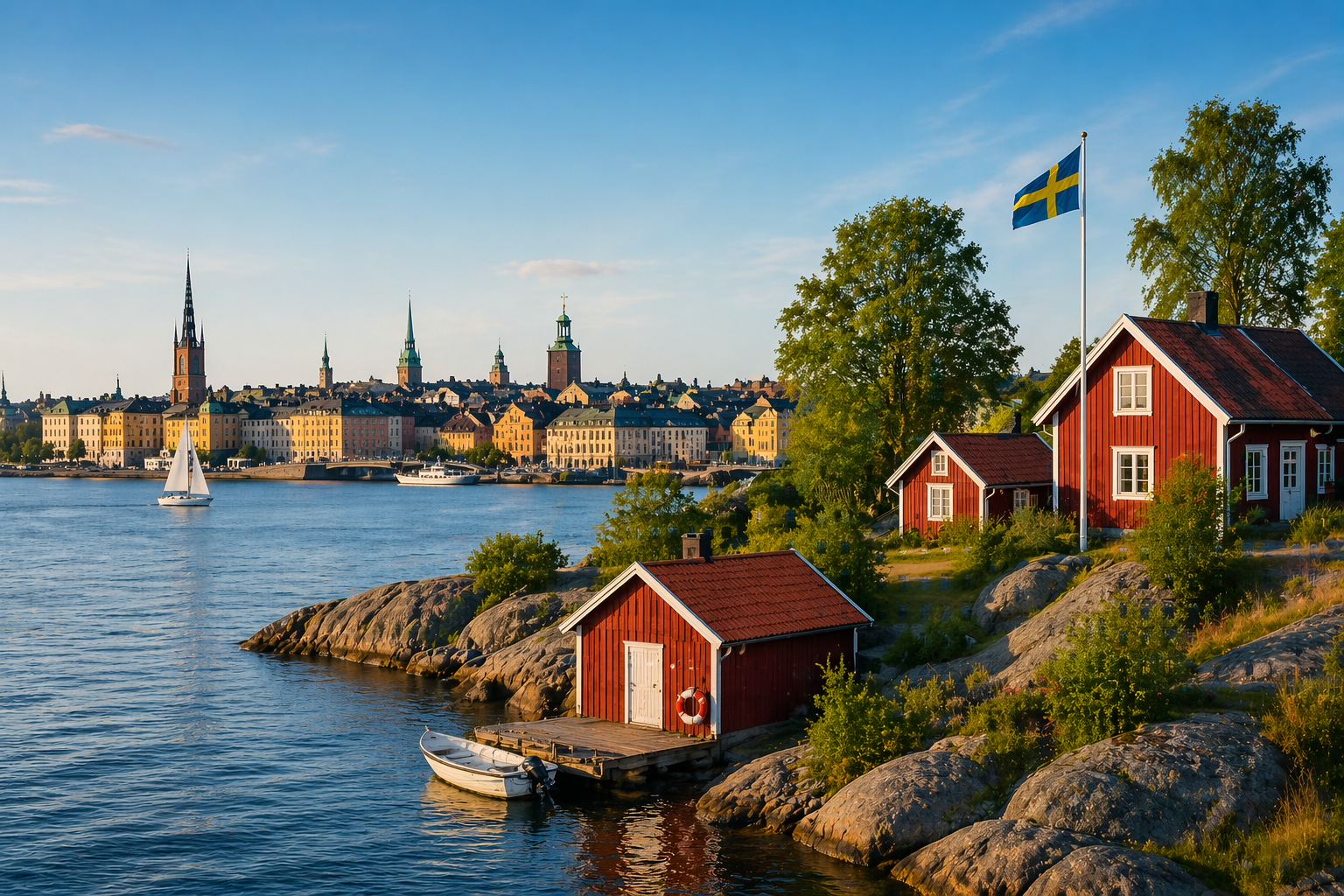
Sweden – Facts, Figures and Overview
Sweden is one of the largest and at the same time least densely populated countries in Europe. For many people, it is an attractive destination for emigrating, but in many ways it differs significantly from countries like Germany. This overview gives you the most important insights into geography, population, economy and everyday life.
General Information
Sweden, officially the Kingdom of Sweden, is a constitutional monarchy in Northern Europe. The country is a member of the European Union but has its own currency, the Swedish krona (SEK). The capital, Stockholm, is the political, economic and cultural center of the country.
Population and Distribution
Sweden has a population of around 10.5 million people. Compared to its size, the population density is very low. While countries like Germany are densely populated, Sweden’s inhabitants are spread across vast areas.
One striking feature is that most people live in the southern part of the country. The largest cities are Stockholm, Gothenburg and Malmö. The northern region, often referred to as Norrland, is sparsely populated and characterized by nature, forests and wide open landscapes.
Geography and Landscape
With an area of approximately 450,000 square kilometers, Sweden is one of the largest countries in Europe and significantly larger than Germany.
The landscape is highly diverse:
- Large forest areas cover most of the country
- There are more than 100,000 lakes
- The coastline is dotted with islands and archipelagos
- Mountain ranges can be found in the north
This natural diversity is a key part of life in Sweden and plays an important role in everyday life.
Climate and Seasons
The climate in Sweden varies greatly depending on the region.
In the south, temperatures are relatively mild and comparable to northern Germany. In central Sweden, winters are colder and snow is more common. In the north, long and cold winters are typical, while summers are marked by phenomena such as the midnight sun.
One important aspect that is often underestimated is daylight. Winters can be very dark, especially in the north, while summers offer very long days.
Economy and Standard of Living
Sweden is one of the economically strong countries in Europe and offers a high standard of living. The social system is well developed, and the country is highly digitalized and innovation-driven.
Well-known Swedish companies include IKEA, Volvo, H&M and Spotify. The economy is export-oriented and focuses on technology, industry and services.
Language and Society
The official language is Swedish. At the same time, most Swedes speak very good English, which makes it easier for newcomers to settle in.
Swedish society is considered modern, open and strongly focused on equality. Topics such as work-life balance, family-friendliness and sustainability are highly valued.
A typical cultural element is “fika,” a coffee break that often includes social interaction and is an important part of daily life.
Everyday Life and Special Features
Sweden is more digitalized than many other European countries. Administrative processes, banking and many everyday tasks are handled online.
Cash is used less and less, with most payments made by card or mobile payment systems.
Another unique feature is the so-called “right of public access” (Allemansrätten). It allows everyone to freely move in nature, hike or camp, as long as certain rules are respected.
Conclusion
Sweden is a large, nature-rich country with a relatively small population and a high standard of living. The combination of a modern society, strong digitalization and a close connection to nature makes the country unique – but also different in ways that require some adjustment.
Comments (0)
No comments yet. Be the first!
Submit comment